Context-based pedestrian path prediction
Abstract
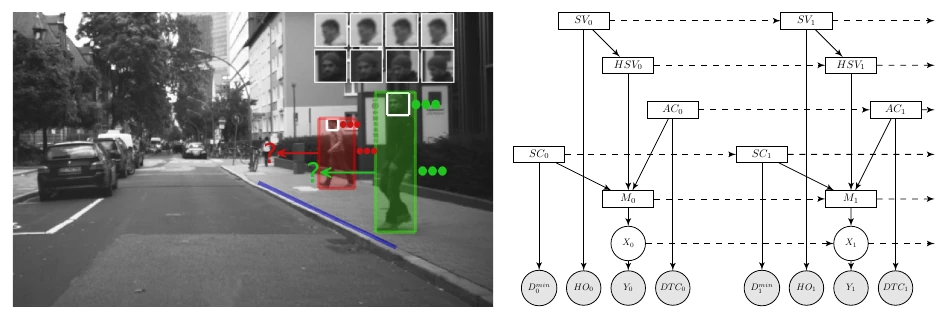
We present a novel Dynamic Bayesian Network for pedestrian path prediction in the intelligent vehicle domain. The model incorporates the pedestrian situational awareness, situation criticality and spatial layout of the environment as latent states on top of a Switching Linear Dynamical System (SLDS) to anticipate changes in the pedestrian dynamics. Using computer vision, situational awareness is assessed by the pedestrian head orientation, situation criticality by the distance between vehicle and pedestrian at the expected point of closest approach, and spatial layout by the distance of the pedestrian to the curbside. Our particular scenario is that of a crossing pedestrian, who might stop or continue walking at the curb. In experiments using stereo vision data obtained from a vehicle, we demonstrate that the proposed approach results in more accurate path prediction than only SLDS, at the relevant short time horizon (1 s), and slightly outperforms a computationally more demanding state-of-the-art method.
Citation
@inproceedings{Kooij2014Contextbased,
title = {Context-based pedestrian path prediction},
author = {Julian F P Kooij and Nicolas Schneider and Fabian B Flohr and Dariu M Gavrila},
year  = {2014},
date = {2014-01-01},
booktitle = {European Conference on Computer Vision (ECCV)},
pages = {618--633},
publisher = {Springer},
keywords = {},
pubstate = {published},
tppubtype = {inproceedings}
}