Recurrent Neural Network Architectures for Vulnerable Road User Trajectory Prediction
Abstract
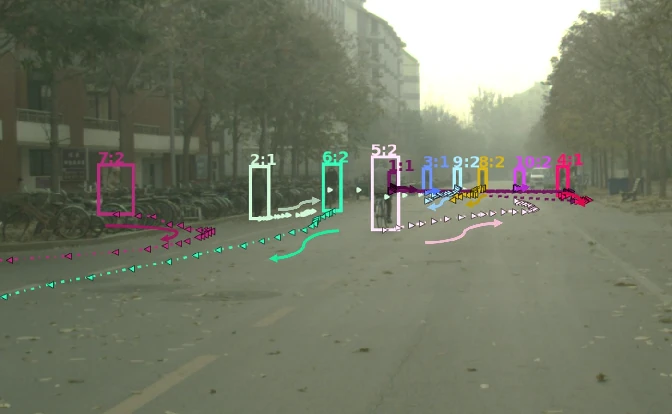
We present an experimental study comparing various Recurrent Neural Network architectures for the task of Vulnerable Road User (VRU) motion trajectory prediction in the intelligent vehicle domain. Making use of temporal motion cues and visual appearance features, we design multi-cue RNN-based architectures with dedicated optimization process to predict future moving trajectories from historical consecutive frames. Experiments are performed on image sequences recorded from on-board a moving vehicle and public tracking datasets. In particular, the Tsinghua-Daimler Cyclist Benchmark (TDCB) has been augmented with additional annotations (various VRU types) to support the evaluation of object tracking approaches and trajectory prediction methods. This newly introduced dataset is termed TDCB-Track. We demonstrate the effectiveness of the proposed RNN architectures on the public MOT16 dataset and the TDCB-Track dataset. We show that the proposed approaches outperform simpler baseline methods and stay ahead with the state-of-the-art.
Citation
@inproceedings{Xiong2019RecurrentNeu,
title = {Recurrent Neural Network Architectures for Vulnerable Road User Trajectory Prediction},
author = {Hui Xiong and Fabian B Flohr and Sijia Wang and Baofeng Wang and Jianqiang Wang and Keqiang Li},
year  = {2019},
date = {2019-01-01},
booktitle = {IEEE Intelligent Vehicles Symposium (IV)},
pages = {171--178},
publisher = {IEEE},
keywords = {},
pubstate = {published},
tppubtype = {inproceedings}
}