Driver and pedestrian awareness-based collision risk analysis
Abstract
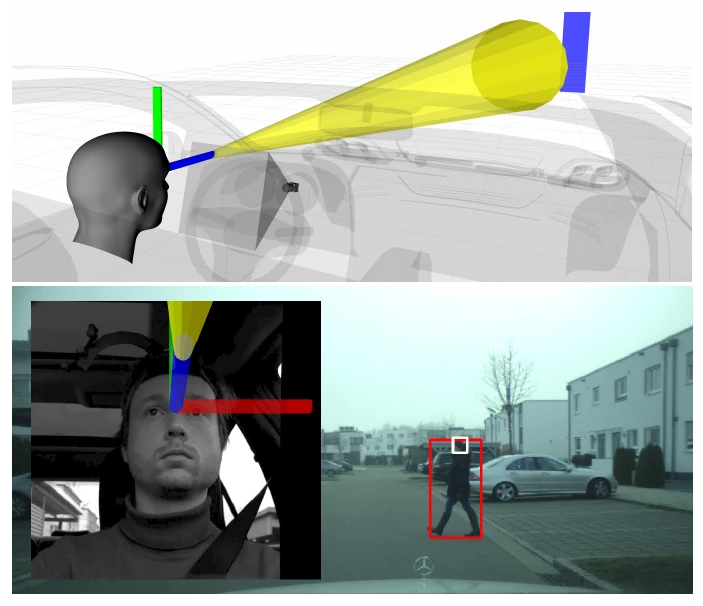
We present a novel approach for vehicle-pedestrian collision risk analysis that incorporates mutual situational awareness, a degree of potential motion coupling and the spatial layout of the environment. The approach uses a Dynamic Bayesian Network (DBN) for modeling the individual object paths; collision risk is subsequently computed by an intersection operation. More specifically, the proposed DBN consists of two subgraphs for modeling pedestrian and vehicle path, respectively. They consist of latent states on top of Switching Linear Dynamical Systems (SLDSs) to anticipate changes in object dynamics. The pedestrian and vehicle-related sub-graphs contain latent states to model whether the pedestrian has seen the oncoming vehicle, and conversely, whether the driver has seen the pedestrian (associated measurements involve the respective head orientations). The pedestrian-related sub-graph furthermore contains a latent state modeling whether the pedestrian is at the curbside or not. Finally, a latent state is shared by the two sub-graphs, which models the potential motion coupling (i.e. at full awareness of the other traffic participant). We consider the scenario of a crossing pedestrian, who might stop or continue walking at the curb, in combination with an approaching vehicle, that might stop or continue driving. In experiments we illustrate that with the proposed approach, a more anticipatory driver warning and/or vehicle control strategy can be implemented.
Citation
@inproceedings{Roth2016Driverandped,
title = {Driver and pedestrian awareness-based collision risk analysis},
author = {Markus Roth and Fabian B Flohr and Dariu M Gavrila},
year  = {2016},
date = {2016-01-01},
booktitle = {IEEE Intelligent Vehicles Symposium (IV)},
pages = {454--459},
publisher = {IEEE},
keywords = {},
pubstate = {published},
tppubtype = {inproceedings}
}