LIE
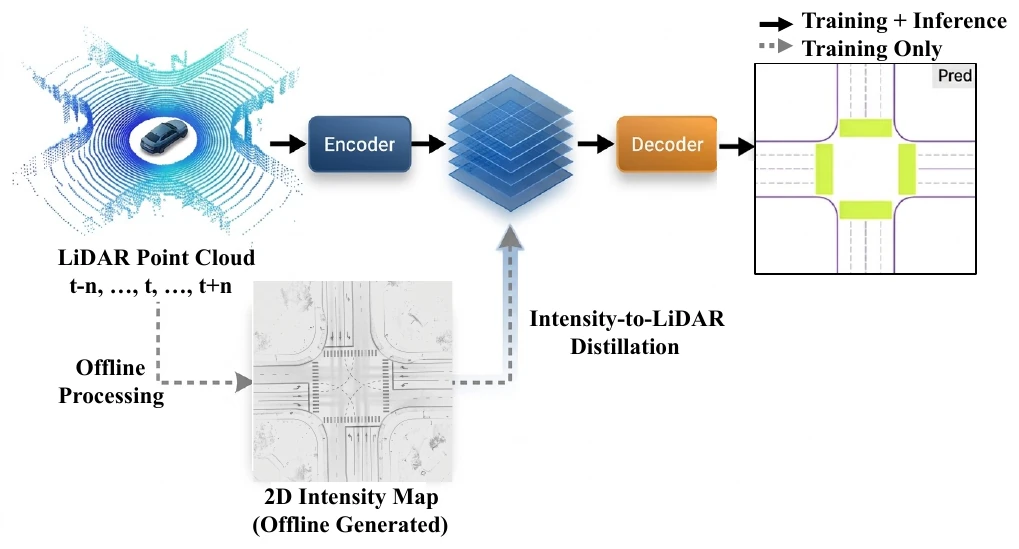
A LiDAR-only mapping model that learns from camera features during training and does without them at inference — useful when the cameras are blinded but the scanner is not.
What it does
LiDAR intensity carries much of the lane-marking signal that models usually take from images. LIE enhances the intensity channel and distils the missing appearance cues from a camera teacher during training, so the deployed model needs only the scanner.
Abstract
Online High-Definition (HD) map construction is a key component of autonomous driving. Recent methods rely on multi-view camera images for cost-effective HD map segmentation, but cameras lack depth information for accurate scene geometry. In contrast, LiDAR provides precise 3D measurements but lacks dense semantic cues. In this work, we propose LIE, LiDAR-only semantic map construction method that employ Knowledge Distillation (KD) to handle the lack of dense semantic and texture cues. Specifically, the teacher branch fuses student LiDAR features and the corresponding 2D intensity map tile to provide dense supervision for segmenting map elements using online distillation scheme. Experimental results show that our method outperforms all single-modality approaches, achieving 8.2% higher mIoU than the state-of-the-art camera-based model on nuScenes. LIE is robust over long ranges and under challenging weather and lighting, and efficiently adapts to Argoverse2 with only 10% fine-tuning, surpassing camera-based models trained on the full dataset. Source code will be available here.
Result
Citation
@inproceedings{Mazumder2026LIE,
title = {LIE: LiDAR-only HD Map Construction with Intensity Enhancement via Online Knowledge Distillation},
author = {Kanak Mazumder and Fabian B. Flohr},
url = {https://arxiv.org/pdf/2605.01478},
year  = {2026},
date = {2026-01-01},
urldate = {2026-01-01},
booktitle = {International Conference on Intelligent Transportation Systems (ITSC)},
publisher = {IEEE},
keywords = {},
pubstate = {published},
tppubtype = {inproceedings}
}