Generative Model Based Data Augmentation for Special Person Classification
Abstract
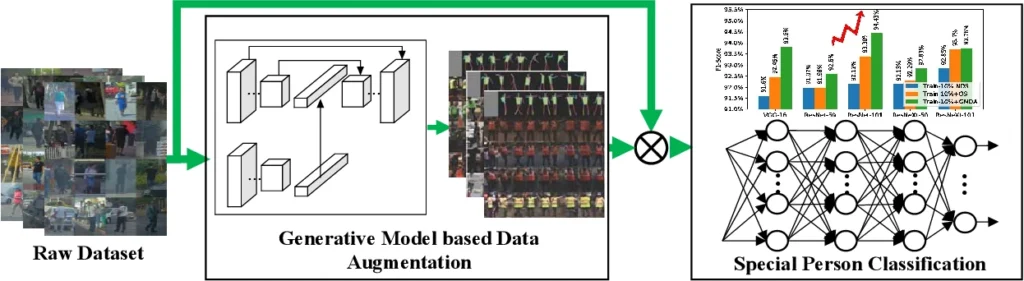
Big data leads to a great success of deep learning in computer vision. Unfortunately, big datasets are often not balanced in all dimensions and rare cases are often underrepresented. On-board data collection by a moving vehicle can capture thousands of normal pedestrians and vehicles, but what about special persons like police officers, road workers, and school guards? Not only that those types of classes are hard to get, they are crucial to be recognized and classified as such for the task of automated driving. Future self-driving cars need to interact with their environment and need to also understand and follow the signals and instructions of those special persons. In this paper, we show how to classify special person types using Convolutional Neural Networks. The big data imbalance is handled by data augmentation using Generative Models, showing a clear advantage over classical data augmentation. The classification performance of special persons can be significantly improved using our Generative Model based Data Augmentation.
Citation
@inproceedings{Guo2020GenerativeMo,
title = {Generative Model Based Data Augmentation for Special Person Classification},
author = {Zijie Guo and Rong Zhi and Wuqiang Zhang and Baofeng Wang and Zhijie Fang and Vitali Kaiser and Julian Wiederer and Fabian B Flohr},
year  = {2020},
date = {2020-01-01},
booktitle = {IEEE Intelligent Vehicles Symposium (IV)},
publisher = {IEEE},
keywords = {},
pubstate = {published},
tppubtype = {inproceedings}
}