Machine Learning
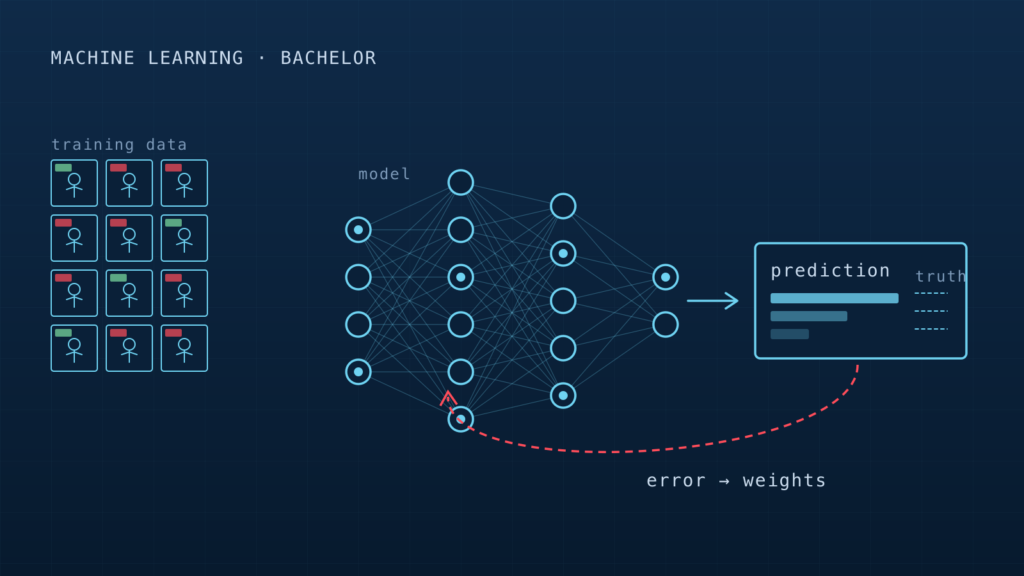
From the first linear model to a deep network you design, implement and train yourself — and the judgement to tell which task needs which method.
DegreeBachelor
FormatLecture with lab
LanguageEnglish
Three courses that build on each other: the methods, the perception, and the whole functional chain of a self-driving vehicle — each with a lab part on real data and real hardware.
From the first linear model to a deep network you design, implement and train yourself — and the judgement to tell which task needs which method.
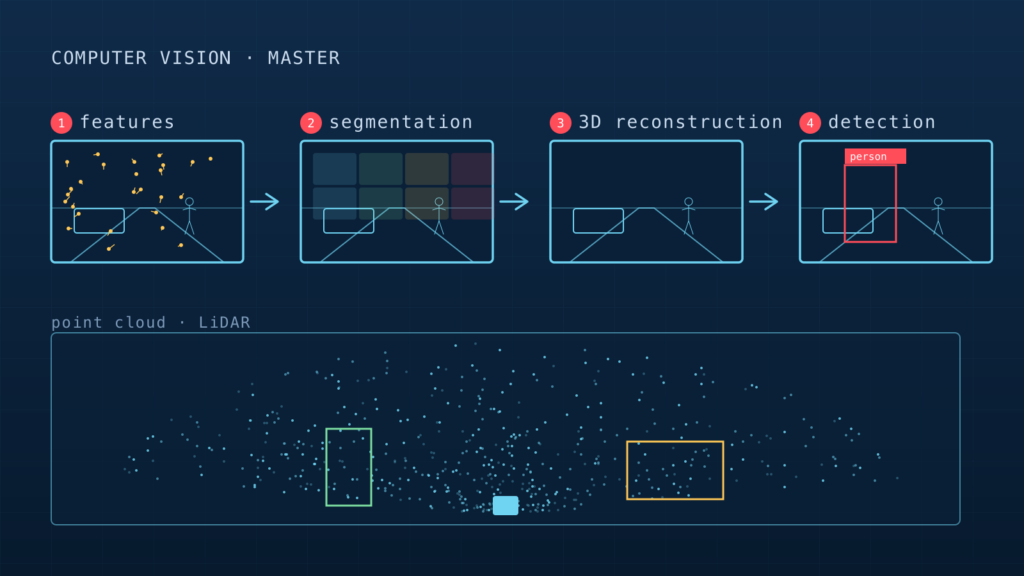
Digital image processing up to modern perception: features, segmentation, motion, 3D reconstruction, detection — and point clouds, with examples straight from industry.
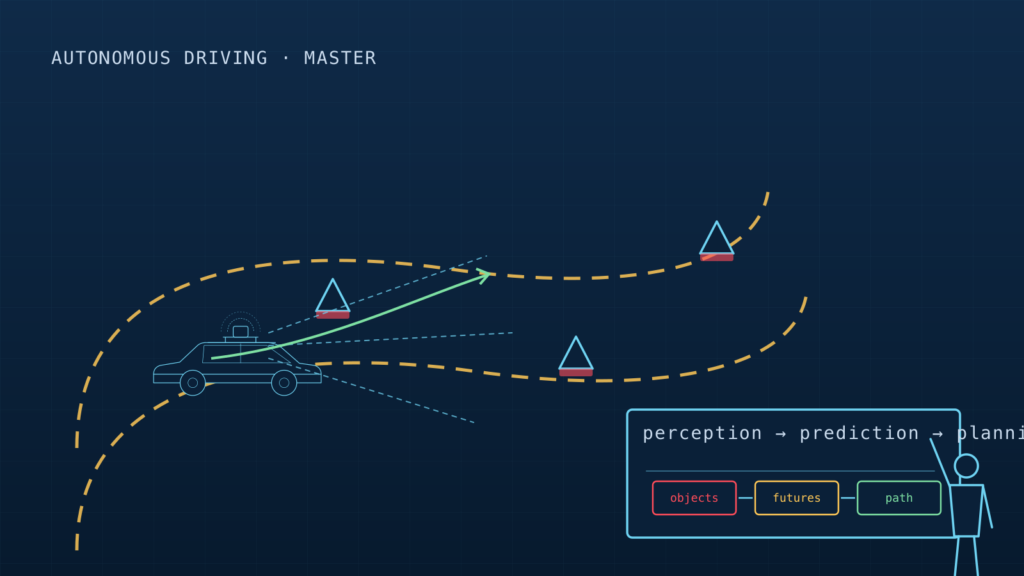
The whole functional chain of a self-driving vehicle — sensors, perception, prediction, planning — implemented on a small vehicle that has to drive the course on its own.
Take a vectorised HD map of a real Munich intersection and turn it into a CARLA town that HABIT can run scenarios in, so we can evaluate on the places we actually record.
Python, CARLA, some 3D tooling. Good if you like making things fit together.
SatMap uses satellite imagery as a prior, LIE enhances LiDAR intensity. Combine the two: use the scanner where the imagery is stale and the imagery where the scanner is blind, and measure what each contributes.
PyTorch, 3D geometry, willingness to work with nuScenes and our own recordings.
Diffusion policies and language-model planners both produce trajectories, and they fail in different ways. Implement both in our closed-loop CARLA setting and find out where each breaks.
PyTorch, CARLA or a willingness to learn it, curiosity about generative models.